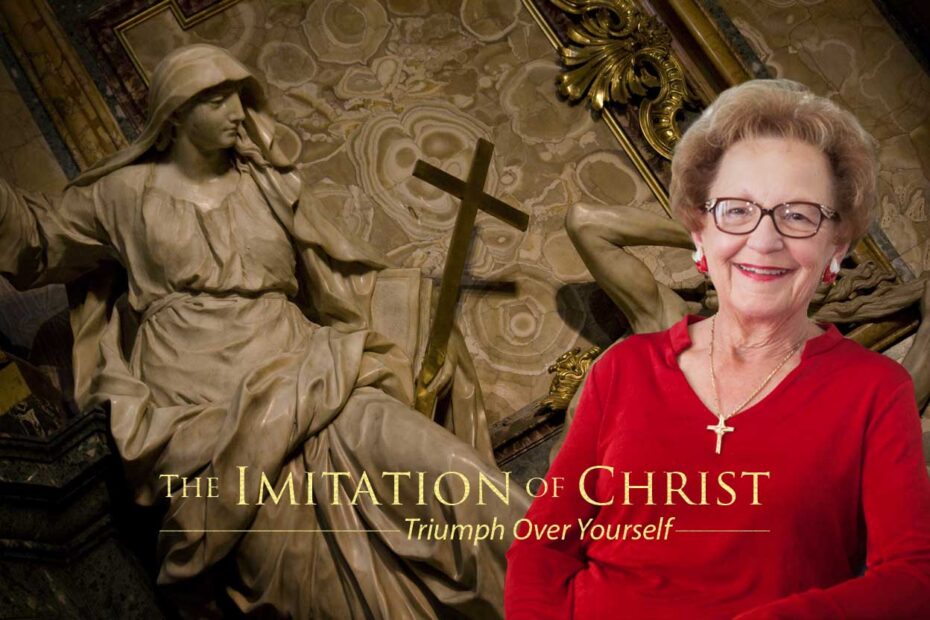
By Judie Brown
Many years ago, American Life League’s spiritual director and dear family friend Father Denis O’Brien, MM, suggested to me that it would be wise to read one paragraph of Thomas à Kempis’ The Imitation of Christ every day. At the time he said we might be tempted to read more than that, but in order to truly allow the wisdom of à Kempis to soak in, one paragraph a day was sufficient.
Father O’Brien’s influence on our family was far too great to explain here, but we believe you will see the obvious wisdom in his recommendation in the following paragraphs, which in my mind is one of the most profound reflections in The Imitation of Christ:
What great confidence at the hour of death shall be his who is not attached to this world by any affection. But the sickly soul does not know what it is to have a heart thus separated from all things, nor does the natural man know the liberty of the spiritual man. Yet, if he truly wishes to be spiritual, he must renounce both strangers and friends, and must beware of no one more than himself.
If you completely conquer yourself, you will more easily subdue all other things. The perfect victory is to triumph over self. For he who holds himself in such subjection that sensuality obeys reason and reason obeys Me in all matters, is truly his own conqueror and master of the world.
These words encapsulate the fundamental definition of someone who recognizes in Christ all that is good, all that is perfect, and all that is truly human. The challenge, as à Kempis writes, is to first be capable of such self-control so that one may be ready to strive to imitate Christ.
In our world today we find so many examples of those who have not wanted to be capable of self-discipline, preferring instead the pursuit of all manner of evil in a quest to be what some would call master of the universe. Such a desire is folly, and as we have seen in today’s culture, it is the single most horrific threat to the dignity of the human person. Examples of this tragic condition are everywhere.
But there are also examples of people who have strived to live a life for Christ’s truths despite attacks from the culture of death. In Scotland, an American teacher was removed from her position because she explained to her students the reasons why she opposed abortion. And closer to home, Bishop John O. Barres of the Diocese of Rockville Centre, New York, and a group of Catholic nuns from various orders have sued the state’s attorney general and commissioner of health over a law that would force them to participate in “the process of physician-assisted suicide.”
The courage exhibited by the educator in Scotland and by Bishop Barres and the sisters exemplifies the reason why in becoming subservient to Christ we find the inner strength to never back down from anything that is contrary to the truth as taught by Christ.
There is great consolation in recognizing our human weakness, our need for the Lord’s grace, and our commitment to Him in all things, including proclaiming the sanctity of life. As Archbishop Alexander Sample of Portland, Oregon, once said, “Most people don’t realize that since Roe v. Wade in 1973, over 63 million unborn children have lost their lives to abortion just here in the United States. The scale of the evil of abortion is truly a global, historic tragedy.”
Only those who understand the basic reality of how abortion has decimated our population are willing to applaud the words of shepherds like Archbishop Sample. And yet, like others cited here, the archbishop is showing us that it is possible to triumph over your personal weakness when you know that Christ is by your side.
To our way of thinking, this is the road less traveled by some but the one paved with the grace to allow each of us to be good and faithful servants. Proverbs 9 affirms that triumph over self is the beginning of wisdom.