By Judie Brown
HALO is the acronym for one of the most compelling pro-life organizations in America today. HALO stands for Healthcare Advocacy and Leadership Organization, and it serves as “a voice for the medically vulnerable.” Its work challenges the status quo on questions regarding death and dying.
We receive HALO’s email updates regularly and have come to see how vitally important they are in our quest to defend life. Below are a few examples for you to consider.
On the question of brain death, Julie Grimstad, vice president of HALO, wrote this regarding a type of organ donation called donation after controlled circulatory death (DCD):
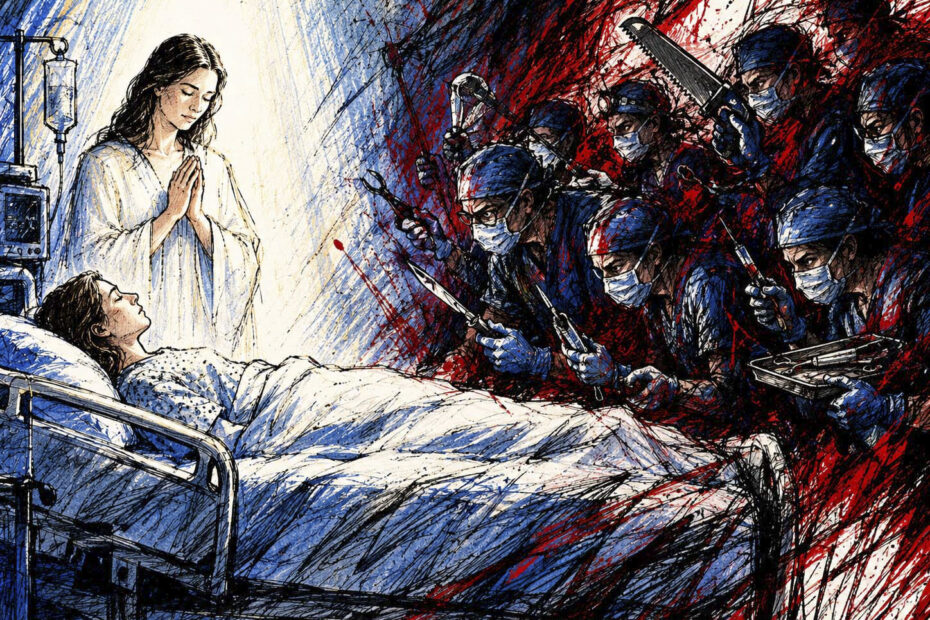
DCD is a type of organ donation that is increasingly prevalent in the United States, though it is forbidden in a number of other countries. Patients who are candidates for DCD have not been declared “brain dead.” These are patients with poor prognoses. Either they or their legal representatives (usually family members or healthcare proxies) have decided their quality of life is unacceptable and have agreed to organ donation. The donor’s death is planned to occur at a specific time and place so that organs can be harvested while they are fresh and still viable.
Such a heinous practice should never be allowed, of course. Yet we understand that in the United States, the value of a person’s life is not undeniable but rather fungible in terms of when and where it should either be welcomed or dismissed. The Gift of Hope Organ & Tissue Donor Network says this about donation after controlled circulatory death: “To facilitate vital organ recovery, the patient must be maintained on a ventilator, have a functional arterial line and be hemodynamically supported for organ perfusion until the withdrawal of life-sustaining medical treatment/support occurs.”
In other words, if the patient is really dead, his organs cannot be used, so life is sustained artificially until the organs are taken. This is a very devious way of describing murder.
Of course, not every dying person faces her final moments in exactly the same way. And Grimstad shared with her readers an excellent commentary by Priests for Life entitled “Preaching on Euthanasia.” Focusing on the question of when to treat or not treat a patient, we read:
The distinction here is not between “artificial” and “natural.” Many artificial treatments will be “ordinary” means in the moral sense, as long as they provide some benefit without excessive burden. It depends, of course, on the specific case in point, with all its medical details. We cannot figure out ahead of time, in other words, whether or not a relative or we ourselves want some specific treatment to be used “when the time comes,” because we do not know in advance what our medical situation will be at the time. When the time does come, however, we must consult on the medical and moral aspects of the situation.
As we ponder this, we should always keep in mind that every individual is unique no matter their age or condition. This fact can help us sort through the weeds of medical practices and opinions, some of which are themselves causes of death.
As Grimstad writes in “What Does ‘I Want to Die’ Mean?”:
If a person believes there is no existence after death, that is not peace, it is nothingness. On the other hand, if there is existence after death (I believe there is), is a particular individual who commits suicide destined to “rest in peace” or make his or her unfortunate situation immeasurably worse?
No one can truthfully tell a person who asks for assisted suicide what will happen to him or her after death. So, what can family members, friends, and caregivers say to this person? They can assure the person, “We love you. We do not want you to kill yourself. We will accompany you on this final journey, assist you with the daily tasks of living, and surround you with comfort and peace.” As the physical body declines, the individual’s sense of spirituality may deepen. Caregivers can pray for and/or with the person and ask if he or she would like visits from a priest, minister, rabbi, or other spiritual director.
The wisdom of these words cannot be emphasized enough, especially in the era of “choice” regarding welcoming a new baby into the world or ushering a loved one on to her eternal destination. We are our brother’s keepers, but we are also the voice that cries out in a time of suffering that God loves you, and so do I!
In his Gospel, Saint Matthew teaches, “Be cunning as snakes and yet innocent as doves.” This wisdom has never been more desperately needed.
We urge you, if you have not already done so, to join HALO’s mailing list to receive updates and alerts (you can read past alerts here). You will be so glad you did!