By Judie Brown
Saint Justin Martyr, an early Church father, wrote in 155 AD of the Eucharist: “For not as common bread and common drink do we receive these; but in like manner as Jesus Christ our Savior, having been made flesh by the Word of God, had both flesh and blood for our salvation, so likewise have we been taught that the food which is blessed by the prayer of His word . . . is the flesh and blood of that Jesus who was made flesh.”
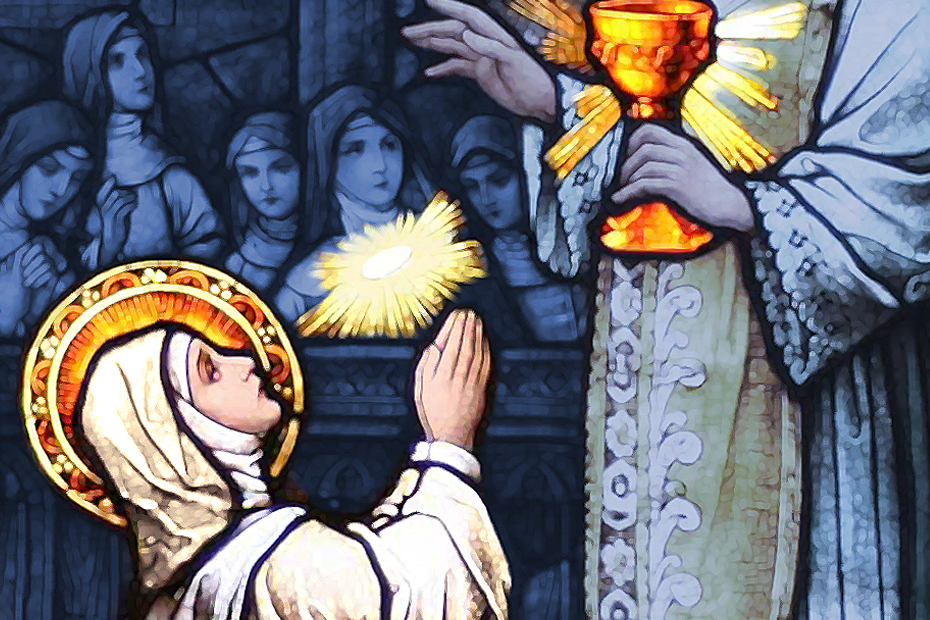
Anyone who recognizes Christ’s real presence in the Eucharist is at once reminded of the human being’s unworthiness to contemplate, let alone receive, this incredible blessing given to us by the Lord Himself at the Last Supper. It is the continuing realization of this blessed event that called us to learn about a young Italian girl whose love for the Eucharist knew no bounds. Blessed Imelda Lambertini was born in Bologna, Italy, in 1322. According to a Church POP article, “At nine years of age, she begged her parents to allow her to live with the Dominican nuns. Even though it was a difficult decision, her parents permitted her to live in a neighboring monastery and entrusted her faith formation to the Dominicans at Val di Pietra.”
While Lambertini lived just a short time, her devotion to the Eucharist has inspired many people. Her most memorable statement was “Tell me, can anyone receive Jesus into his heart and not die?”
One article about this amazing young girl who was granted the Dominican habit at the age of 11 tells us,
Though only a child, she worked hard at obeying the order’s rules and doing the right thing. She became a role model for many of the sisters who lived with her. Sister Imelda found a corner in the rear of the convent garden and built a small replica of Calvary there. She would go there and meditate on the sufferings of Jesus. The one thing that Sister Imelda longed for more than anything was to be united with Jesus through Holy Communion.
We found her story incredible, inspiring, and indicative of the true meaning of loving Christ in the Eucharist, not only during Mass but in every moment of our lives. In our age of machines, gadgets, and other paraphernalia, we are called to work harder at concentrating on the divine in preference to the mundane and on teaching about the real presence of Christ in the Eucharist, for far too few understand this crucial truth.
The Center for Applied Research in the Apostolate recently found that just 64% of those Catholics surveyed said they believe in the real presence. How can this be so? A Catholic News Agency article suggests that there is a gap between Church teaching and personal belief among Catholics, and it is this discrepancy that is most troubling.
To help us understand, the Church has blessed us with memorable devotees of the Eucharistic Christ, such as Saint Tarcisius, Saint Carlo Acutis, Saint Peter Julian Eymard, and so many others. In fact, if we consider this in the context of the current state within the Church, we cannot help but wonder why one hundred percent of Catholics do not bow in worship at the very notion, let alone the ability to receive, Christ in the Eucharist.
In many Catholic Churches today, we stand to receive the body of Christ, rather than kneel. Is that the reason? Writing in “The Devil Has No Knees: On Kneeling and Reception of the Eucharist,” Patrick O’Hearn opined, “Kneeling is one of the most profound acts of humility and reverence. Kneeling proclaims with St. Paul: ‘At the name of Jesus every knee should bow, in heaven and on earth and under the earth’ (Phil. 2:10). The devil recoils at the sight of those who receive Our Lord with the greatest humility and piety, for the devil has no knees.”
In our opinion, that statement describes exactly where the problem of earnestly adoring Christ begins to dissipate. As Catholics, we are called to humility before Christ, but as people who have lost their way, many have forgotten this. That is why it is so important for us to insist on the truth that binds our love for the preborn child to the love of Christ Himself: If average Catholic people cannot devoutly believe in the real presence of Christ in the Eucharist, how can they stand up and proclaim the real presence of the preborn child growing within her mother?
The most pro-life act any of us can perform is our commitment to believe and teach that the real presence of Christ compels us to defend the innocent, especially those who are unseen and yet truly present among us.