By Susan Ciancio
This weekend we celebrate the feast of an incredibly courageous man who saved countless lives. Nicholas Owen was born in England in the mid-1500s during the time when the Protestant government punished practicing Catholics and priests with torture and even death. Years prior, King Henry VIII had become angry with the pope because he would not grant him an annulment, which would have allowed him to remarry within the Church. Wanting his own way instead of heeding Church teaching about the sanctity of marriage, Henry left the Catholic Church, divorced his wife anyway, and formed the Anglican church, forcing the entire country to join him or face dire consequences and even death.
Later, under the reign of Queen Elizabeth I, England’s authorities violently persecuted Catholics. During this time, the Jesuits had been sent to England to help spread the faith, but they understood that if they were discovered, they could be killed. This prompted many faithful Catholics to hide them in their homes. However, spying neighbors would often alert authorities that a priest was present, so Catholics had to come up with a way to protect themselves and the priests. Nicholas Owen was the perfect man for the job.
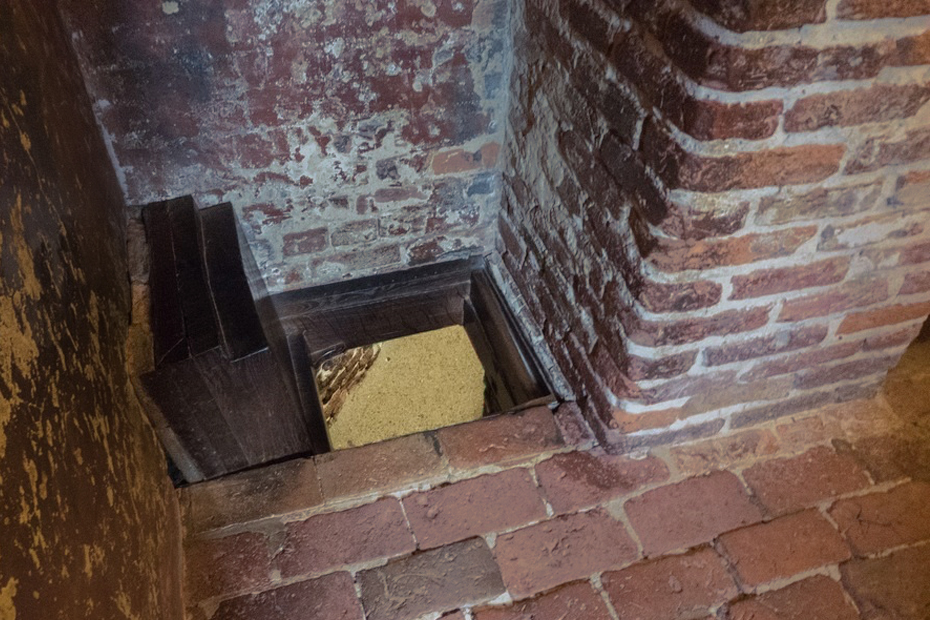
A skilled laborer and architect, Nicholas began crafting hiding places within the walls and flooring of people’s homes. These spaces were often small and sometimes hidden within other hiding places, so if one hiding place was discovered empty, the authorities stopped looking, not knowing that the priest was often one panel away.
It is said that Nicholas built these hiding places around England for more than 20 years. He so loved the faith that he eventually became a Jesuit lay brother.
In 1594, he was caught, arrested, and tortured, but he would not divulge the names of any Catholics. Someone paid his ransom, and he was released. He continued to build priest holes, never allowing fear to stop him from protecting these priests or the families they served. In 1606, Nicholas was again arrested. This time he was brutally tortured and killed. He was canonized in 1970.
Moral courage
While on one hand, it’s fascinating to ponder the existence of these priest holes and the workmanship of Nicholas Owen, on the other hand, the reality is that every time one of these priests said Mass, he was putting his life in jeopardy, and every time Nicholas crafted one of these hiding spaces, he was putting his life in jeopardy.
Sometimes the priests had to hide in these small holes for days at a time, as the Protestant authorities who raided houses would often lie in wait after they left to see if the priests would emerge. But because standing up for our faith and saying Mass was paramount to Nicholas and to these priests, they willingly risked their lives.
As parents, we can use their examples to teach our kids to have moral courage when it comes to standing up for their faith, to proudly proclaiming Christ’s truths, and to caring for those around them. Not many of us, especially in America, are persecuted for our faith, but this is not the case in other countries, and we are blessed to be able to go to Mass without fear any day we desire.
Like St. Therese of Lisieux, we must understand that grand, courageous actions are important, but small actions are meaningful and important as well. We are not all called to do great things like build priest holes, travel around the world evangelizing, or die for our faith, and that’s okay. Moral courage doesn’t have to always entail life-or-death situations. We can do little things with great love, and these little things matter. The key is to be consistent and faithful and to use our actions to help shape our society into one that respects all people—from creation until death.
Below are 25 things that even the smallest of children can do to show the people around them that they are valued and that God is first in their lives. Practice these things daily, adding a few into your days at a time, and work your way up to not just performing these small works of faith and kindness but making this a way of life.
- Pray for others. Keep a notebook of prayer intentions to refer to.
- Speak kindly and say “please” and “thank you.”
- Listen politely without interrupting.
- Include someone who feels left out.
- Go to Mass at least weekly.
- Share your possessions or donate gently used games and toys to shelters.
- Bake cookies for someone who needs a pick-me-up.
- Say the rosary or read a book about a saint.
- Refrain from making fun of others.
- Say “excuse me” instead of pushing past someone.
- Apologize when you hurt someone (even by accident).
- Accept someone else’s apologies and don’t hold grudges.
- Read about the parables and discuss how they apply to your life.
- Smile and greet people politely.
- Wait patiently while in lines.
- Hold the door open for others.
- Be kind to people who are different from you and welcome them into your friend group.
- Stand up for someone who is being bullied (or get help for them).
- Speak kindly, even when upset.
- Do something nice for an elderly neighbor or someone who is sick.
- Give sincere compliments.
- Learn about the sanctity of life and marriage.
- Clean up after yourself in public spaces so the custodian has less work.
- Draw a picture for a grandparent or your parish priest.
- Joyfully help a family member with a chore.
In essence, we should all treat the people around us the way we want to be treated, and we should live our faith openly and proudly. At the end of our lives, when we give God an accounting of all that we have done—both good and bad—we will see just how much of an impact all those little things had on those around us. And if we have rejected the bad and sinful things, we will hopefully hear those words we all long to hear: “Well done, my good and faithful servant.”
Download our lesson booklet about St. Therese to start a conversation about the little things you and your family can do to build a culture of life in your homes and communities.