By Judie Brown
The Catholic dictionary defines evil as “the privation of a good that should be present.” It continues, “[Evil] is the lack of a good that essentially belongs to a nature; the absence of a good that is natural and due to a being. Evil is therefore the absence of what ought to be there.”
There are so many examples of this situation in America today that we hardly know where to begin, though it is obvious that one of the severe crises is the silence within Catholic leadership on the undeniable truth that Christ is truly present in the Eucharist. Let me explore a recent debacle in Chicago by way of example.
Catholic priests were stopped by federal officials from administering the Eucharist to immigrants being held in a federal facility in Chicago. This occurred even though social activist Father Larry Dowling points out that “a law was passed a number of years ago by the state of Illinois that says chaplains can go into the detention facilities.”
However, the truth is not quite what people like Dowling want us to believe. Professor John Grondelski investigated this event and wrote 10 observations about it. Among them was this: “Access to detention and restricted government facilities is not ‘on-demand.’ Priests know this. Chaplains know that they need to make prior arrangements to enter such places.”
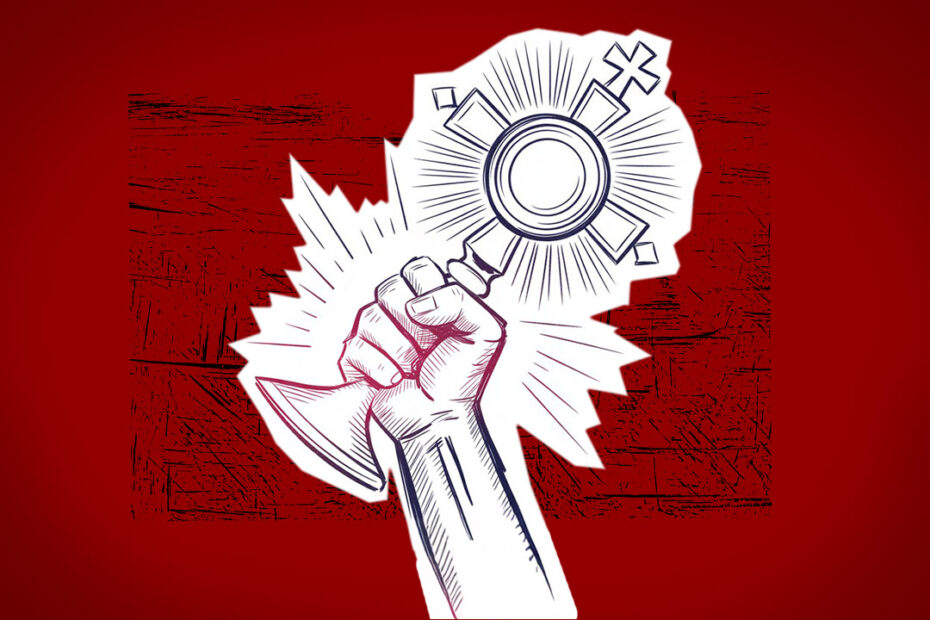
In other words, the reporting that suggested that Dowling was acting in accord with the law is at odds with facts. This is a prime example of what happens in the absence of good. The Eucharist is not a sacrament that should be in the center of a false drama. Dowling was not acting for the good but rather was using histrionics for the wrong reasons. Using the real presence of Christ for political organizing is evil to the core. As Catholic Vote president Kelsey Reinhardt said, “The Church is not a theater. And since the Eucharist is the heart of the Church, it should not be instrumentalized as a tool in a political campaign.”
Further, Grondelski wrote, “When public processions of the Eucharist were organized throughout the United States in 2024 en route to the National Eucharistic Congress in Indianapolis, the Archdiocese of Chicago, ironically, was one of the few that objected to such public displays of Eucharistic faith.”
Was the disparity in behaviors to make a political statement?
Yet Catholic malcontents are not the only ones fostering fiendish behaviors. Recently Kurt Kaufman, a Baptist pastor, said, “Being in favor of reproductive rights, first and foremost, protects the life of the mother, and protects the life of the person that is already living, and is the person that is able to bring more life into this world should they choose.”
According to LifeSiteNews, Kaufman said that “babies should be killed in the womb so they do not grow up in an ‘unsupportive’ situation.”
Kaufman’s views represent someone whose worldview is formed in the absence of goodness, justice, and truth. And yet he is an “ordained” minister.
Such events occur with increasing frequency. We suggest that one of the reasons for this is rejection of the truth as set forth by God. Being created in His image is a blessing, but when man rejects Him because he has exercised his free will, disturbing things can happen. As the Church teaches, every person is the “master over his own acts.”
This is one reason why we should contemplate the words of this prayer: “Almighty ever-living God, who in the abundance of your kindness surpass the merits and the desires of those who entreat you, pour out your mercy upon us to pardon what conscience dreads and to give what prayer does not dare to ask. Through our Lord Jesus Christ, your Son, who lives and reigns with you in the unity of the Holy Spirit, one God, for ever and ever.”
Without prayer, reliance on the mercy of God, the humble awareness of our human frailty, and a right-thinking conscience, anyone can perform acts in the absence of good. But if her conscience has been properly formed, no thinking person can choose evil. Every day, this is something we must strive for—for ourselves and our children.